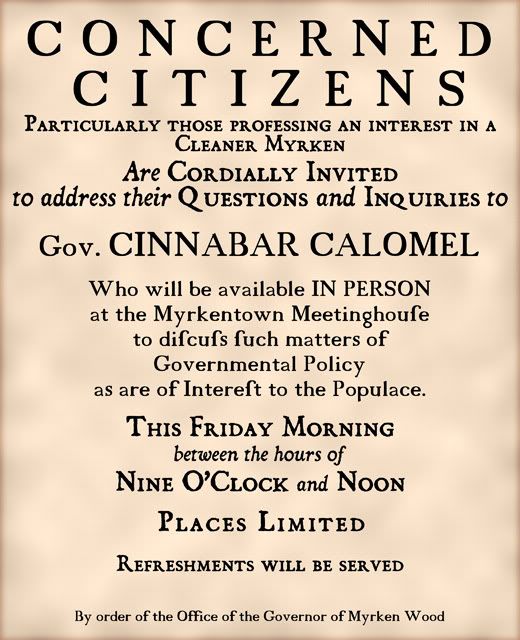
by Cinnabar » Sun Jul 06, 2008 2:53 am
The appearance of the pamphlet is hardly surprising - a brief rearranging of the papers on the lectern indicates that he has his own copy of the document to hand, a brief skim to reacquaint himself with its contents before he looks back to Sir Malaroth. The Governor offers only a mild shrug at the supposition that they are the reason for this meeting, but no particular challenge given - people believe what they will, clearly. He listens as the knight speaks, attentive and focussed, waiting for him to finish before composing his answer.
"To call them advertisements is to give them rather more credit than they deserve. While the facts given are general enough to be broadly true, the conclusions drawn from them are utterly without merit, founded on little more than ignorant assumptions and base speculation. You are quite correct, however, that I deny the allegations of any involvement either in Jan Baker's murder, or Councillor Spier's extended absence." Firm in tone, gaze briefly moving across the crowd as if to see whether any might challenge his assertion. Looking back to the Grand Master, he continues.
"With respect, I feel it is misleading to compare Baker's murder and the Ashfiend's campaign of terror against Myrken Wood. On the one hand we have a man murdered in his home, as you say, with a fairly large number of potential suspects to be questioned and evaluated. On the other, we have a creature who butchered scores - no, hundreds of people in displays of shocking violence, and whose killings were notable for their brutality, and the ghoul's utter disregard for concealing his responsibility for the attacks. As such, the differences in these cases makes any attempt at comparison quite spurious, sir, and any attempt to imply that lack of perceived progress in one case compared to the other is due to sinister plots and devious conspiracies is laughable. In the Baker case, it was difficult to discern the identity of the murderer; in the Ashfiend case, it was difficult to dispute it." A pause to regard his notes again, before grey eyes lift once more to the knight.
"That the Baker case remains unresolved is one of the more erroneous assumptions in this supposed web of intrigue. On closer inspection it became clear that the case was a good deal more involved than was first apparent, and required considerable delicacy in its pursuit. I will not go into details here, out of respect for the reputations of those involved, but suffice to say it was determined that Jan Baker's killer acted in the defence of others, and that he was far from the blameless victim of - what was it? - dark machinations that this pamphlet portrays." Some hint of anger at that, a controlled outrage kept carefully in check. Perhaps a wish that the full facts might be made public, were it not for the damage that such revelations would inflict upon the case's other victims.
"The Baker case is closed, the investigation complete. The details remain confidential, however, in order that those involved need not be forced to endure public disgrace on top of the injuries already inflicted upon them. Clearly those prone to such habits will speculate and spread scurrilous untruths as a result, but I stand by the integrity of the investigation, and of those officers involved in it." The Governor clears his throat, then, taking a deep breath and moving on.
"Meanwhile, the assertion that my farm is run differently from almost any other in Myrken is something of an exaggeration. At the time I purchased the property, the farm's tenants were indentured workers who had been contracted to Jan Baker for a considerable length of time, and on the basis of whose toil the Bakers prospered while the workers themselves lived in poverty. Indeed, I do not feel I mis-speak when I say that the use of indentured labour amounts to little less than slavery by another name, and there is no place for it in any civilised land. It is a practise open to all manner of abuse - Baker's indentured workers had paid off their debt many times over, and yet twenty years after their arrival in Myrken Wood they still toiled for him, bound in contractual chains that should have been removed years before. It is a stark example of the difference between that which is lawful, and that which is just. It is my hope that as Governor I will be able to eliminate such discrepancies, to bring justice and the law into harmony with one another." Vehement in this assertion, passionate in his desire to promote not just what is lawful, but what is right. He recalls himself in the next moment, a deliberate moderation of tone and features before he continues.
"To address your query, following my acquisition of the Baker property I ended the workers' contracts and offered them what I felt to be a fairer agreement, to which they agreed. In short, I own the land and they work it as tenants, and the property's output is divided between us. You might view it as my paying them for their labour, or them paying me for the use of my land. Either way, the concept of tenant and landlord is hardly a new one, nor indeed particularly uncommon. It is different from the situation during Baker's time, but that is by no means a bad thing. For a start, my tenants are entirely free to leave the agreement at any time, should they so desire, though I am pleased to say that very few have chosen to do so. " A certain pride at that, a certain sense of vindication that he has been fair in his dealings with the farm's workers, that he has won their loyalty without need for threats or blackmail or intimidation or any of the other methods of which his detractors accuse him. That he has done what is right.
"I hope that answers your questions, sir."
Omnia mutantur, nos et mutamur in illis.